

Hey there! If you’ve ever wondered about using BMI Calculator Male for your body mass index, you’re in the right place. This tool is designed for guys who want to get quick answers without all the fuss. Checking your body mass index doesn’t have to be complicated. Just input your height and weight, and voilà—you’ll get a number that really matters.
Check your BMI with our calculator 👉
Many men tend to shy away from the scale, but knowing your numbers is a smart move for your health. It takes less than a minute! This guide will walk you through the entire process, from entering your stats to understanding what those results mean for your body.
Plus, this calculator is free and easy to use, specifically tailored for men. Whether you’re just curious or actively trying to lose weight, this is your starting point for a clearer picture of your health. Think of your body mass index as a quick snapshot of your health, not a full documentary.
By the end of this article, you’ll know how to use the calculator, what your number signifies, and how to take action based on that information.
Key Takeaways
- Quickly find your body mass index with a simple tool.
- No confusing jargon—just straightforward numbers.
- Knowing your weight status is essential for your health.
- Learn how to interpret your results effectively.
- Understand related measurements like the Ponderal Index.
What Is BMI Calculator Male and Why It Matters
Let’s chat about what body mass index really means. In simple terms, body mass index (BMI) is a measurement that looks at the relationship between your height and weight. It helps you understand if you’re in a healthy weight range or if you might need to make some changes.
This tool has been around for decades and is widely used by doctors and health organizations. The beauty of BMI is its simplicity. You take your weight and divide it by your height squared. This method allows everyone to compare their numbers fairly, whether you’re tall or shorter.

Once you calculate your BMI, you get a number that places you into one of four categories:
- Underweight
- Normal weight
- Overweight
- Obese
Each category has its own health implications. Knowing where you stand can be a wake-up call. It might encourage you to pay more attention to your diet or physical activity levels.
While BMI is a useful starting point, it doesn’t measure body fat directly. For most people, it does a decent job of estimating body fat levels. Think of your BMI like the check engine light in your car. It signals when something might need a closer look, but it doesn’t provide all the answers.
How to Use a BMI Calculator Male: Step-by-Step
Check your BMI with our calculator 👉
Let’s dive into how you can easily find your body mass index. Using this tool is straightforward, and all you need are two numbers: your current height and weight. That’s it—no complicated formulas or math required!
What Numbers You Need: Height and Weight
For height, you’ll enter it in feet and inches if you’re using US units. For example, if you’re 5 feet 10 inches tall, you’d put in 5 for feet and 10 for inches. Your weight goes in pounds. Just hop on the scale and use whatever number you see—no need to strip down!
Calculating BMI with Feet, Inches, and Pounds
If you prefer metric, there’s a tab for that too. You can plug in centimeters and kilograms to get the same result. The calculator does all the heavy lifting for you. It takes your weight in pounds, multiplies it by 703, and then divides that by your height in inches squared.
Quick Example Calculation for Men
Let’s walk through a real example. Say a guy is 5’10” and weighs 160 pounds. His height is 70 inches, so the calculation would be:
BMI = (703 × 160) ÷ (70 × 70) = 23.0 kg/m²
This means he lands right in the normal weight zone, which is exactly where you want to be! Once you hit calculate, you’ll see your BMI number, your weight category, and even your healthy weight range for your specific height.

Plus, the calculator shows you a visual scale, helping you see exactly where your number falls between underweight and obesity. It’s that simple!
Interpreting Your BMI Number: What the Ranges Mean
Your BMI number isn’t just a figure; it’s a window into your health status. Once you’ve got your BMI number staring back at you, the next step is figuring out what that number actually means for your health.
The World Health Organization breaks it down into four main buckets:
- Underweight: Anything below 18.5
- Normal weight: Between 18.5 and 24.9
- Overweight: Ranges from 25 to 29.9
- Obesity: Starts at 30 and goes up from there
These cutoffs are the same for adult men and women, so there’s no separate chart for guys versus gals once you’re past age 20. If your number falls in that 18.5 to 24.9 sweet spot, you’re considered to be at a healthy weight for your height, which is associated with the lowest risk for weight-related health problems.
The healthy weight range shifts depending on how tall you are. For instance, a guy who’s 5’4″ has a healthy range of about 108 to 145 pounds. Meanwhile, a 6-footer’s healthy range runs roughly from 140 to 184 pounds.
To give you a concrete example, a man who stands 5’10” hits the overweight category once he’s between 174 and 202 pounds. He’s considered obese at 209 pounds or above. The calculator will actually show you your personal healthy weight range based on the height you entered, which takes all the guesswork out of it.
If you’re more of a visual person, BMI charts exist too. These charts display height on one axis and weight on the other, so you can find your intersection and see which color zone you land in. Remember that these ranges are guidelines based on population data, and your individual situation might call for a slightly different interpretation.
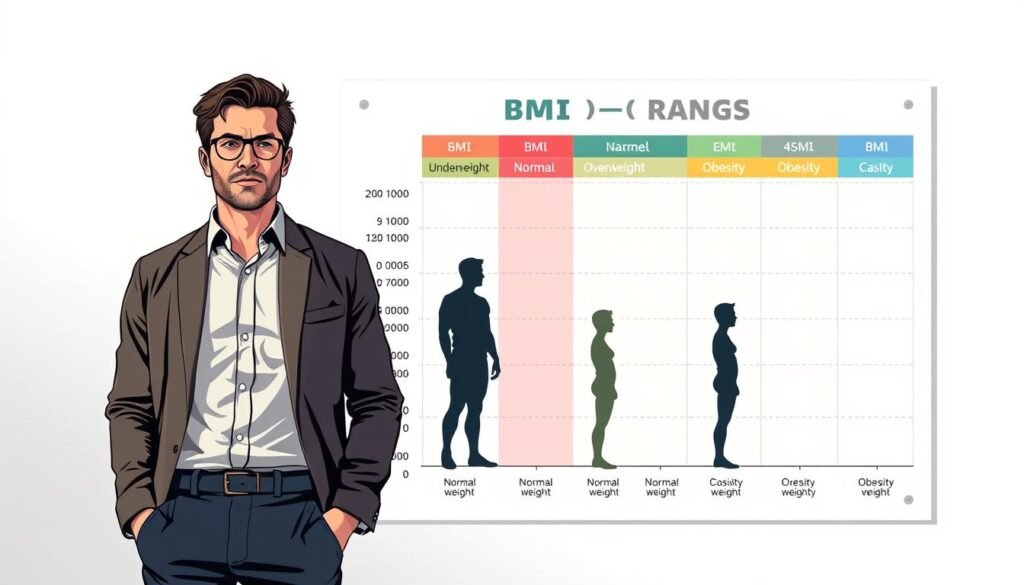
Health Risks Linked to Different BMI Levels
Check your BMI with our calculator 👉
Understanding the health risks tied to your weight can make a big difference in your overall well-being. Both ends of the weight spectrum—being overweight or underweight—carry their own unique challenges. Let’s break down the dangers associated with a high BMI and why being underweight can also pose serious health risks.
The Dangers of Having a High BMI
Carrying extra weight isn’t just about how your jeans fit; it’s linked to some pretty serious health problems that the CDC has been tracking for years. When your BMI creeps into the overweight or obese range, your risk goes up for:
- High blood pressure: This puts extra strain on your heart and blood vessels day after day.
- Cholesterol issues: Bad LDL cholesterol can climb while good HDL cholesterol drops, leading to clogged arteries.
- Type 2 diabetes: A higher BMI increases the likelihood of developing this condition, affecting everything from energy levels to kidney function.
- Heart disease and stroke: These heavy hitters are directly tied to carrying excess body fat over time.
- Other conditions: Gallbladder disease, osteoarthritis, and sleep apnea can also arise, leaving you tired and foggy during the day.
- Cancers: Certain types, like colon and kidney cancer, show up more often in people with obesity.
Why Being Underweight Can Also Be Risky
But the risks aren’t all on the heavy side. Being underweight comes with its own set of problems:
- Malnutrition: Not getting enough nutrients can lead to vitamin deficiencies and anemia.
- Weaker bones: This can lead to osteoporosis, making fractures more likely.
- Decreased immune function: A weaker immune system means you may not fight off infections as well.
- Growth issues: In children and teens, being underweight can hinder growth and development.
- Reproductive issues: Women may face hormonal imbalances, leading to complications like a higher chance of miscarriage.
- Surgical complications: People who are underweight often face increased risks during surgery.
The bottom line is that both ends of the spectrum carry increased health risks compared to staying in that normal weight range. It’s essential to monitor your weight and understand the potential implications for your health.
| Weight Category | Health Risks |
|---|---|
| Overweight | High blood pressure, high cholesterol, type 2 diabetes, heart disease, certain cancers |
| Underweight | Malnutrition, osteoporosis, weakened immune system, growth issues, reproductive complications |

Things to Remember: Limitations of BMI Calculator Male
Check your BMI with our calculator 👉
When it comes to understanding your health, BMI has its quirks. It’s important to know that this number isn’t the whole story. While it can give you a quick idea of your weight status, it doesn’t tell you everything about your body composition.
Here’s the thing about BMI that doesn’t get talked about enough: it can’t tell the difference between a pound of fat and a pound of muscle. If you’re a guy who hits the gym regularly and has built up some serious muscle, your BMI might flag you as overweight or even obese when you’re actually in great shape.
Bodybuilders are a classic example. A guy with very low body fat and lots of lean muscle can have a BMI of 30, which technically says “obese.” But anyone looking at him would know that’s ridiculous.
Why Muscle Mass Can Skew Your BMI Results
As men age, they naturally lose muscle mass. So, a 65-year-old with a BMI of 24 might actually have a higher percentage of body fat than a 30-year-old with the same BMI. This makes age a significant factor in BMI accuracy.
Women generally have more body fat than men at the same BMI. This is worth knowing if you’re comparing numbers with your wife or girlfriend. Ethnicity also plays a role; research shows that standard BMI cutoffs might overestimate risk in some groups and underestimate it in others, particularly for people of Asian descent.
Age and Other Factors That Affect BMI Accuracy
For about 90 to 95 percent of the population, BMI does a decent job of estimating body fat. But that still leaves millions of people for whom the number is misleading. That’s why smart doctors don’t rely on BMI alone. They’ll also look at your waist size, diet, activity level, and family history before making any judgments about your weight.
If you’re an athlete or you’ve been lifting for years, take your BMI with a grain of salt. Focus more on how you feel and perform. Remember, BMI is just one piece of the puzzle. For a more comprehensive view of your health, consider additional measurements like waist circumference or body composition analysis.
Beyond BMI: Tools Like BMI Prime and Ponderal Index
When it comes to assessing your weight, there are some handy tools beyond just BMI. Once you’ve got your head around basic body mass index, you can explore a couple of related measurements that can give you an even clearer picture of where you stand.
What Is BMI Prime and How It Helps Assess Weight
BMI Prime is a simple concept. It’s just your BMI divided by 25, which is the upper limit of the normal weight range. So, if your BMI is 23, your BMI Prime is 0.92. This tells you right away that you’re at 92 percent of the way to the top of the normal range.
Here’s how the categories break down:
- A BMI Prime under 0.74 means you’re underweight.
- Between 0.74 and 1 is considered normal.
- Anything over 1 is overweight.
- Over 1.2 puts you in the obesity category.
The nice thing about BMI Prime is it gives you a single number that instantly shows how far you are from that normal weight cutoff. No need to memorize the full range chart!
A Quick Look at the Ponderal Index for Different Body Types
The Ponderal Index (PI) takes a different approach by cubing your height instead of squaring it. This may sound complicated, but it actually works better for people at the extremes of height. If you’re really tall or on the shorter side, the Ponderal Index might give you a more accurate read on your body composition than standard BMI does.
For example, let’s use our 5’10”, 160-pound guy again. His Ponderal Index comes out to:
PI = Height (in) / ∛Mass (lbs)
So, for him, it’s:
PI = 70 / ∛160 = 12.9 kg/m³
This falls in the normal range. These tools aren’t meant to replace BMI; they’re just extra lenses you can use to look at your weight from different angles.
The calculator we’re discussing here actually computes all three of these numbers at once, so you get BMI, BMI Prime, and Ponderal Index in a single click.
| Measurement | Formula | Category Interpretation |
|---|---|---|
| BMI | Weight (lbs) / Height (in)² x 703 | Underweight, Normal, Overweight, Obese |
| BMI Prime | BMI / 25 | Underweight (1), Obese (>1.2) |
| Ponderal Index | Height (in) / ∛Weight (lbs) | More accurate for extreme heights |
Tips for Using Your BMI Calculator Male to Track Your Health
Check your BMI with our calculator 👉
Keeping an eye on your weight is more than just a one-time check; it’s a journey. Regularly checking your BMI can help you stay informed about your health and make necessary adjustments. It’s like having a little health buddy that nudges you in the right direction.
Try plugging your numbers into the bmi calculator every few months, perhaps at the change of seasons. This way, you can see if things are moving in the right direction or starting to drift. Remember, your weight naturally fluctuates by a few pounds from day to day, so don’t stress about tiny changes. What matters is a steady trend over several months.
How Regular Checks Can Help You Stay on Top of Your Weight
If your BMI has been creeping up year after year, that’s a signal that your habits might need a little tuning. Catching these trends early can prevent your weight from reaching a point that’s harder to reverse. On the flip side, if you’ve been working on losing weight, regular checks can be a satisfying way to see your progress in black and white.
When to Talk to a Doctor About Your BMI Results
There comes a point where you should loop in a doctor. This is especially true if your BMI is consistently in the obese range or if it drops into underweight territory without you trying. A doctor can look at your BMI alongside other factors like blood pressure, cholesterol, and family history to give you a fuller picture of your health.
For older guys, the BMI rules get a little fuzzy. Some research suggests that a BMI between 25 and 27 might actually be protective for people over 65. This range can help cushion against muscle and bone loss that naturally occurs with age. If you have a family history of heart disease, diabetes, or certain cancers, your doctor might want you to aim for a lower BMI than the general guidelines suggest.
Remember, the calculator is just a tool. Use it to stay informed, but have real conversations with a professional when something doesn’t look right. Your health is a team effort!
Taking Charge: Using Your BMI Results to Make Smart Choices
Getting your results is just the beginning; let’s talk next steps. If your number is in the normal range, that’s fantastic! But don’t forget about your eating habits, activity level, and family history. These factors are just as important for your overall health.
If your results show you’re in the overweight or obese range, even a modest weight loss of 5 to 10 percent can lead to better health outcomes. You don’t have to change everything overnight. Simple changes like swapping soda for water or adding a walk after dinner can make a difference.
Remember, building muscle through strength training is also beneficial. Focus on how your clothes fit and your energy levels rather than just the number on the scale. It’s a good idea to discuss realistic weight goals with your doctor, especially if heart disease or diabetes runs in your family.
Check your BMI with our calculator 👉
Your weight index is a helpful starting point, but combine it with regular checkups and a healthy lifestyle. The fact that you’re checking your weight means you’re already on the right path!