
So, you’ve probably wondered about that infamous number, right? It seems like a simple question, but once you start looking into it, things get a bit strange. This number pops up everywhere—from elevators skipping that button to sports jerseys that hardly anyone wants to wear.
Now, here’s something cool: mathematically speaking, this number has some impressive credentials. It’s prime, a Fibonacci number, and even gets a nod as a lucky number in number theory. Yet, there’s a darker side too. Ever heard of triskaidekaphobia? That’s the official term for fear of this number, and it’s been around since at least 1911.
What’s fascinating is that this debate isn’t just ancient folklore. People still argue about it today! It influences real decisions, like building designs and even house prices. Some believe the superstition ties back to lunar calendars, where 12 full moons fit neatly in a year, leaving that extra one feeling a bit off.
In this article, we’ll explore both sides of the story—bad luck tales and good luck traditions. Let’s figure this out together!
Key Takeaways
- This number raises interesting questions about luck and superstition.
- Mathematically, it has some impressive qualities.
- Fear of this number has a name: triskaidekaphobia.
- Debates about its luckiness still affect real-life decisions.
- Folklore connects it to lunar calendars.
Is the Number 13 Lucky or Unlucky? Understanding What People Really Think
Have you ever thought about why a simple digit can stir up so much debate? It’s just a number, yet it seems to get under people’s skin. The fascination with this number has been around for quite some time, and it’s worth exploring why.
A recent survey in Britain revealed that 14% of respondents believe this number is inherently unlucky. Another 9% were unsure, meaning nearly a quarter of people are side-eyeing this digit. What’s going on here?
Dr. Juliette Wood, a mythology and folklore expert at Cardiff University, offers an interesting perspective. She argues that the idea of this number being unlucky isn’t rooted in ancient folklore. Instead, it gained popularity as a media creation around the early 20th century. This suggests that the fear surrounding it isn’t as old as many might think.
When researchers dug through historical records, they found no references to this number being unlucky before that time. It seems people love a good story, often reaching back into history to find events that fit the myth. For instance, tales from the Last Supper or Norse mythology are frequently cited to explain this superstition.
Despite knowing it’s just a superstition, many folks still avoid this number just in case. This behavior says a lot about human nature and our tendency to cling to fears.
The question of luck keeps resurfacing because we reinforce it through movies, buildings that skip floors, and various cultural habits. Most people today might take it with a grain of salt, but the belief remains deeply ingrained in our culture, ensuring it won’t fade away anytime soon.
Historical and Religious Origins Behind 13’s Reputation
Ever wonder where the bad reputation of this number comes from? Let’s explore some fascinating stories that contribute to its dark legacy.
The Last Supper: Judas and the unlucky 13
One of the most famous tales revolves around the Last Supper. Picture this: Jesus and twelve apostles gathered for that final meal. In total, there were thirteen people at the table. Judas Iscariot, the disciple who betrayed Jesus, was the 13th guest to arrive. This association with betrayal gave the number a dark reputation in Christian tradition.
This significant event happened on what became Good Friday, linking the guest count and the day itself. Many people believe that having Judas among the thirteen guests contributed to the idea that this number carries bad luck.
Norse Mythology: Loki crashes the party
Shifting gears to Norse mythology, we find another intriguing story. Loki, the god of mischief and deception, was the uninvited 13th guest at a dinner of the gods in Valhalla. His presence led to chaos when he tricked one of Odin’s sons into killing Baldur, a beloved god. This act created another black mark against the number.
Dr. Juliette Wood notes that this connection to Norse mythology likely emerged later, during the 19th Century. British scholars became fascinated with translating those old myths, bringing Loki’s tale into the mix. Ironically, modern Marvel films have transformed Loki into a fan favorite, flipping the narrative of him as the villain at the dinner party.
These two stories are often cited to explain why this number is considered unlucky. While they carry weight in popular culture, the historical timeline doesn’t quite support them as the true origin of the superstition.
Superstitions and Traditions: How the Number 13 Got Its Bad Rap
It’s fascinating to see how this number’s reputation influences our daily choices. One of the most visible examples is the missing 13th floor in many buildings and hotels. Instead of numbering it, they often jump straight from 12 to 14. It’s as if they think ignoring it will make it disappear!
Some places get creative, labeling it as 12A or even using that floor for mechanical equipment. A prime example is One Canada Square in London’s Canary Wharf, which opened in 1990 without a 13th floor. To this day, it remains absent.
Even the iconic London Eye has 32 pods, but they skip the 13th and label one as number 33. This quirky decision is both silly and charming, showcasing how deeply rooted these superstitions are.
Interestingly, houses numbered 13 often sell for less. In fact, some local councils have even banned new developments from using this number due to residents’ discomfort. A construction site in Cardiff recently displayed every floor number except the 13th, proving this isn’t just an old tradition—it’s still happening!
The fear of this number has a name: triskaidekaphobia. This term has been recognized since 1911 and highlights how pervasive this fear truly is. Then there’s Friday the 13th, a day that many dread. The historical significance of this day dates back to Friday, October 13, 1307, when King Philip IV of France ordered the arrest of the Knights Templar, leading to their torture and execution.
In the world of sports, the avoidance continues. The Indianapolis 500 banned the 13th number from 1915 to 2002, while Formula One did the same from 1977 to 2013. Even in triathlons, you won’t find this number; the sequence skips from 12 to 14. In events like the Tour de France, riders assigned this number often wear their race bib upside down as a little act of defiance against the superstition.
The sheer number of industries and places that avoid this number shows how deeply this superstition has wormed its way into everyday life. It’s a quirky reminder of how culture can shape our actions and decisions.
| Context | Example |
|---|---|
| Buildings | One Canada Square, London Eye |
| Real Estate | Houses numbered 13 |
| Sports | Indianapolis 500, Formula One |
| Fear | Triskaidekaphobia |
| Historical Event | Friday the 13th, 1307 |
When 13 Brings Good Luck: A Look at Positive Traditions
Not everyone sees this digit as a harbinger of doom; many cultures celebrate it as a symbol of good fortune. Across various traditions, this number has been embraced as a sign of prosperity and blessings. Let’s explore some of these uplifting stories!
Lucky 13 in France, Italy, Spain, and Egypt
In France, before World War I, this digit was often viewed as a good luck charm. It appeared on postcards and trinkets, symbolizing positive vibes. Similarly, in Italy, people associate it with fortune in football pools, where the phrase “fare tredici” means to hit the jackpot.
Spain also shares this positive view, seeing it as a number linked to good fortune. Meanwhile, in Egypt, it represents prosperity and blessings, flipping the Western superstition on its head.
Bar Mitzvah and Jewish traditions that celebrate 13
In Jewish culture, turning 13 marks a significant milestone. It’s the age when a boy becomes a Bar Mitzvah, fully entering the faith. This tradition highlights the importance of this number in celebrating maturity and responsibility.
America’s love for 13: From flags to seals
In the United States, this digit holds a special place in history. The original colonies gave rise to the first flag, featuring 13 stripes and 13 stars. The Great Seal of the United States further honors this with 13 olive leaves, arrows, and stars.
Colgate University, founded by 13 men with 13 dollars, prayers, and articles, continues to view this number as a good omen. Even modern pop culture embraces it; Taylor Swift often refers to it as her lucky number, celebrating it throughout her work.
Finally, in Sikhism, Guru Nanak Dev Ji experienced a divine moment when he reached this number while distributing groceries. He began repeating “terah”, meaning “yours,” which reflects a profound connection to this digit.
In conclusion, whether it brings good fortune or bad, this digit’s significance varies widely across cultures. The perspective on its luck often depends on where you stand and which tradition you draw from.
| Culture | Significance |
|---|---|
| France | Good luck charm on postcards |
| Italy | Hitting the jackpot in football pools |
| Spain | Symbol of good fortune |
| Egypt | Associated with prosperity |
| Judaism | Bar Mitzvah milestone |
| United States | Historical significance in flags and seals |
| Sikhism | Divine connection through Guru Nanak |
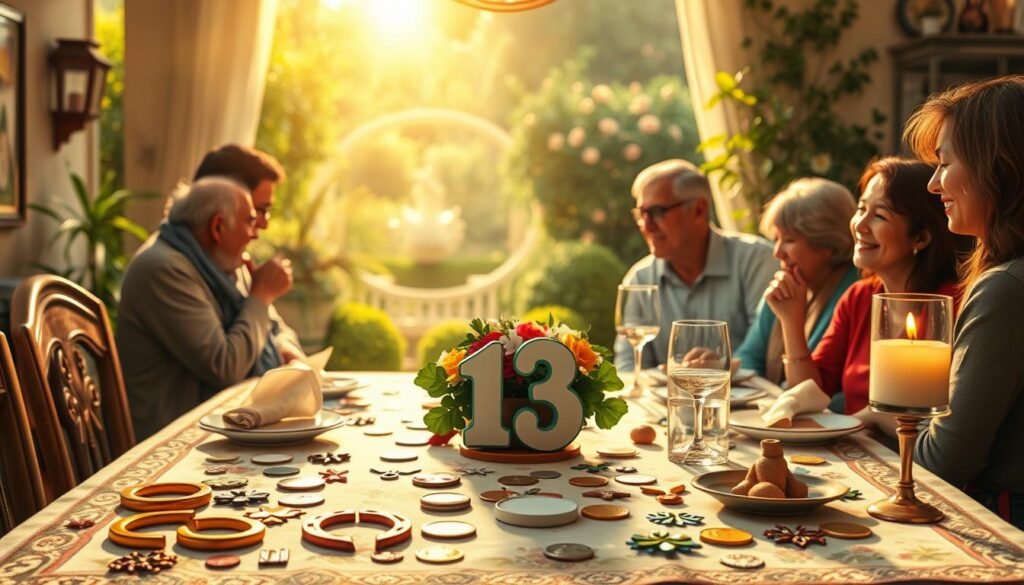
13 in Modern Media and Popular Culture
Have you noticed how much movies and TV shows play into the myths surrounding this number? It’s fascinating how modern media has kept the superstition alive, often more than ancient stories ever could.
Take the Friday the 13th horror franchise, for example. It took this superstition and transformed it into a whole genre of scary movies. The chilling tales and iconic characters have made many people associate this digit with fear.
Dr. Juliette Wood argues that the idea of this number being unlucky is largely a media creation from the early 1900s. It gained traction through films, books, and news stories, embedding itself into popular culture.
Interestingly, in tarot card decks, card XIII represents Death, often depicted with a Pale Horse and its rider. This adds another spooky layer to how people perceive this digit.
On the flip side, let’s talk about Loki from the Marvel universe. This character, who started as the villainous 13th guest in Norse mythology, has been reimagined as a beloved antihero in movies. It’s a fun twist that shows how narratives can evolve over time.
Then there’s Taylor Swift, one of the most visible modern celebrities who embraces this digit. She often writes it on her hand before shows and references it in her music. When someone as famous as Swift celebrates this number, it shifts how younger generations think about it.
Media keeps the myth alive in both directions. Horror movies reinforce the fear, while positive portrayals from celebrities chip away at it. Pop culture has basically turned this digit into a brand. Whether you see it as spooky or lucky often depends on what you’re watching.
| Media Influence | Examples |
|---|---|
| Horror Films | Friday the 13th franchise |
| Tarot Cards | Card XIII (Death) |
| Modern Celebrities | Taylor Swift |
| Character Evolution | Loki in Marvel films |
| Media Creation | Dr. Juliette Wood’s theory |
Living with 13 Today: Luck, Fear, and What It Means Now
It’s interesting how, despite all we’ve learned, many still react oddly when they encounter this number. A recent survey in Britain revealed that 14% of people think it’s inherently unlucky, while another 9% remain unsure. This shows that belief in its bad luck still lingers.
Even in 2024, developers often skip this number when building homes. Katie Griffin from Propertymark confirms that avoiding it remains common in real estate. However, there’s a twist: the Cardiff tower will have a 13th floor with apartments, suggesting a shift in attitudes.
Dr. Wood notes that superstitions give us comfort in a chaotic world. For most, this number has become a quirky habit rather than a real fear. Whether you see it as good or bad likely depends on your upbringing and the stories you’ve heard.
Ultimately, this number stands out, loaded with meaning. Maybe it’s just a digit, but it reflects our beliefs and choices, making it the most fascinating number of all.