
Have you ever noticed how often the number seven pops up as a lucky charm? From slot machines to birthday wishes, it seems to be everywhere. Mathematicians and scientists have actually studied why this digit holds such a special place in our hearts. Their findings might surprise you, revealing more than just old superstitions.
Take Alex Bellos, for example. He ran a massive online poll where over 44,000 people voted for their favorite number. Can you guess which one won? That’s right, nearly 10 percent of the votes went to seven! This fascination isn’t just a modern trend; ancient Babylonian tablets were filled with sevens, showing our obsession goes back thousands of years.
The popularity of this digit comes down to a mix of math, psychology, and culture. It’s not just random chance that makes it feel special. In fact, seven stands out among numbers, often breaking the usual rules. In this article, we’ll explore its religious roots, quirky math traits, and the psychology behind why so many people choose it. So, grab a coffee, and let’s dive into the intriguing world of this fascinating digit!
Key Takeaways
- Seven often appears as a lucky charm in various cultures.
- Studies reveal surprising reasons behind its popularity.
- Alex Bellos’ poll shows seven as a favorite among many.
- Historical records indicate a long-standing fascination with this digit.
- The appeal of seven combines math, psychology, and cultural significance.
What Makes 7 a Lucky Number Around the World?
The allure of the number seven can be seen in traditions and stories from many cultures. It’s fascinating how this digit appears in so many famous lists and beliefs across the globe. For instance, think about the Seven Wonders of the World. This list alone gives seven a special significance, hinting at its importance long before we even dive into religious contexts.
You can’t swing a cat without hitting a famous seven in pop culture and nature. From the seven dwarfs in fairy tales to the seven colors of the rainbow, this number seems to pop up everywhere. Even in music, there are seven notes on a scale, showcasing its universal appeal.
One of the most significant aspects of the number seven is its role in our timekeeping. The structure of the seven days week comes from ancient traditions and ties directly into religious stories. Nearly every culture organizes time around these seven days, making it a foundational element of daily life.
In the Bible, scholars claim that God created the world in six days and rested on the seventh. This day of rest symbolizes completeness, which is why the number seven frequently appears in scripture. It’s a powerful reminder of perfection and fulfillment.
Moreover, both Islam and Judaism reference seven heavens. During the pilgrimage to Mecca, Muslim pilgrims walk around the Kaaba exactly seven times. This practice emphasizes that the significance of seven transcends any single religion.
In Hinduism, there are seven higher worlds and seven underworlds, further illustrating the number’s depth. Buddhism also embraces this digit, with the newborn Buddha taking seven steps after birth, each step representing something meaningful.
Even in Confucianism, seven symbolizes harmony, blending yin, yang, and the five elements into a balanced whole. With so many cultures and religions converging on this single number, it’s no wonder people consider seven lucky across the board.
| Culture/Religion | Significance of Seven |
|---|---|
| Christianity | Symbol of completeness; God rested on the seventh day. |
| Islam | Seven heavens; seven circuits around the Kaaba. |
| Judaism | References to seven in creation and rituals. |
| Hinduism | Seven higher worlds and underworlds. |
| Buddhism | Newborn Buddha took seven steps. |
| Confucianism | Represents harmony among elements. |
The Unique Math Behind Why 7 Stands Out
If the number seven were a person, it would definitely be the rebel at a party, doing its own thing. Mathematically, it stands out among its peers in a way that’s truly fascinating. According to Alex Bellos, seven is the only digit from one to ten that can’t be divided or multiplied by any other number in that same group. This makes it a total outsider.
Let’s break it down. One through five can double into something else within the group, and nine can be divided by three. But seven? It just sits there, refusing to play along with anyone else. This unique characteristic gives it a special significance in the world of numbers.
Why Seven Is the “Outsider” Among Numbers
When you think about it, seven’s rebellious nature is pretty cool. It doesn’t follow the usual rules. This digit is a prime number, which means it can only be divided by one and itself. It’s also a Mersenne prime, a double Mersenne prime, and even a happy number. That’s a lot of math cred for one digit!
The Fascinating Repeating Decimals of One-Seventh
Now, let’s talk about something truly magical: the decimal representation of one-seventh. When you divide one by seven, you get 0.142857, and this pattern repeats forever. If you take two-sevenths, you’ll get 0.285714, which is just a shifted version of that same sequence. All fractions of seven up to six-sevenths use this same repeating sequence, making it unlike anything else in basic arithmetic.
Some Cool Math Facts You Might Not Know About 7
Here are a few more fun facts about the number seven:
- When rolling two standard six-sided dice, seven has the highest probability of being rolled, at one in six.
- The opposite sides of any standard die always add up to seven.
- The Millennium Prize Problems consist of seven unsolved math challenges, each with a million-dollar reward!
With all these unique traits, it’s easy to see why seven stands out in the world of numbers. It’s more than just a digit; it’s a fascinating piece of math history!
| Math Fact | Significance |
|---|---|
| Prime Number | Only divisible by one and itself. |
| Repeating Decimal | One-seventh gives 0.142857, repeating forever. |
| Highest Dice Roll Probability | One in six chance when rolling two dice. |
| Millennium Prize Problems | Seven unsolved math problems with a million-dollar reward each. |
Why Do People Pick 7? The Psychology of a Lucky Number
Let’s explore why the number seven seems to be a favorite among many people. There’s something intriguing about this digit that draws us in. For instance, if you toss a handful of coins on a table, most can instantly tell there are seven without counting. But add an eighth coin, and suddenly everyone’s trying to figure it out.
Keith Devlin from Stanford highlights that seven is the cognitive limit for what psychologists call subitizing. This fancy term means our brains can grasp up to seven things at a glance. This quirk might explain why the number seven feels so natural and comfortable to us.
In Alex Bellos’s poll, many voters described seven as exuding “friendliness and warmth.” It might sound silly, but it makes sense when you think about how our brains process small quantities. Odd numbers generally outperformed even numbers in the poll. Round numbers like five or ten felt too vague since people often say “around 100” instead of exactly 100.
When asked to pick a number between one and ten, many people think they’re being random, but almost everyone lands on seven. This tendency reveals something about how humans struggle with true randomness. People associate the number seven with good fortune, partly because it stands out in their minds as special.
In the end, numerology and superstition build on these psychological foundations. This turns a cognitive quirk into a widespread cultural belief that seven considered lucky just makes sense.
The Story of the Digit 7: From Ancient Symbols to Modern Times
The way we write the digit seven today has a backstory and has changed a lot over the centuries. It’s fascinating to think about how this simple shape evolved from ancient symbols to the modern form we recognize now.
For early Brahmi numerals, seven was written as a curve that looks like an upside-down uppercase J. This design is pretty far from what we scribble today! Western Arab peoples made the longer line diagonal rather than straight, giving it a fresh twist.
Meanwhile, eastern Arab cultures developed a version that resembled an uppercase V. Both of these styles influenced the European two-stroke form, which features a horizontal upper stroke connected to a diagonal line going down to the bottom left corner.
Interestingly, many people around the world still add a line through the middle of seven to distinguish it from the digit one. This practice is common in places like Continental Europe, Indonesia, parts of Britain, Ireland, Israel, Canada, and Latin America. In fact, it’s even taught in primary schools in countries like Russia, Ukraine, France, and Germany!
On digital devices, the digit seven shows off its versatility. On seven-segment displays, it has the most graphic variations of any digit. Most devices use three line segments, but some manufacturers, like Sharp and Casio in Japan, use four segments that add a little hook, making it look more like handwriting.
In some Greek dialects from the early 12th century, the longer diagonal line was drawn as a semicircular transverse line. This shows just how creative cultures can be with their symbols!
The story of how we write this one digit illustrates how culture and practical needs shape even the smallest parts of our daily lives. It’s amazing to think about how something as simple as a digit can carry such a rich history.
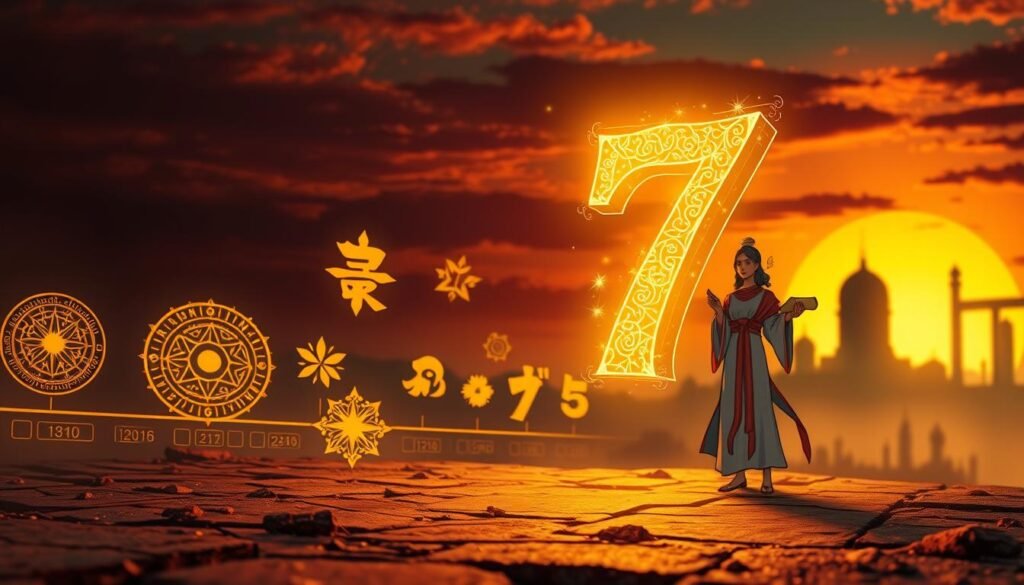
Everyday Examples: 7 in Religion, Folklore, and Pop Culture
Every culture seems to have its own stories and beliefs surrounding the number seven. This digit has a fascinating way of weaving itself into the fabric of our lives. From ancient folklore to modern pop culture, seven appears in countless forms.
The Seventh Son and Magical Powers Myth
One of the most captivating myths is about the seventh son of a seventh son. Many cultures believed this child possessed magical powers, both good and evil. This idea became so popular that it made its way into books, movies, and songs, becoming a staple of fantasy and horror stories that still pop up today.
Lucky 7 in Games, Stories, and Music
When it comes to religion, the number seven shines brightly. In the Bible, God created the world in six days and rested on the seventh day. This belief helped shape the seven days week pattern that many cultures follow today.
In Islam, Muslim pilgrims circle the Kaaba seven times during the hajj. Meanwhile, in Buddhism, the newborn Buddha took seven steps right after being born, with each step marking something profound.
Additionally, the seven deadly sins and seven virtues in Christianity have influenced Western art, literature, and morality for centuries. These lists serve as foundational elements in how people view good and evil.
When it comes to games of chance, the number seven holds a special place. It’s a common motif in slot machines and craps tables, where rolling a seven can mean a big win. Many people even choose sevens when buying lottery tickets or playing lucky numbers.
Music wouldn’t be the same without the seven-note scale. And let’s not forget about storytelling, where we find everything from the seven dwarfs to the seven samurai. This number is deeply embedded in our creative culture.
Whether in religion, folklore, or just a game of dice, the number seven keeps appearing as a symbol of good luck and completeness. Its significance feels almost too consistent to be coincidence.
Why 7 Will Always Hold a Special Place in Our Hearts
There’s something about the number seven that captures our imagination in ways we often overlook. Its appeal isn’t just a coincidence; it’s a blend of math, psychology, religion, and culture all pointing in the same direction. When we group things into sevens, they feel special. Think about the Seven Wonders—it’s no accident we don’t have eight.
Humans are pattern seekers, and we notice seven’s unique properties even if we don’t consciously think about prime numbers or repeating decimals. Part of its charm comes from tradition. We’ve labeled seven a lucky number for so long that it’s become a self-fulfilling prophecy.
Whether you’re into numerology or just enjoy a game of chance, seven feels significant. While some might see it as superstition, there’s real cognitive science behind why seven considered lucky resonates with us. In the end, seven will likely remain the world’s favorite digit—the rebel that stands apart. So, next time someone asks you to pick a number, you’ll know why your brain wants to say seven, and you can smile, knowing you’re part of a tradition thousands of years in the making.