
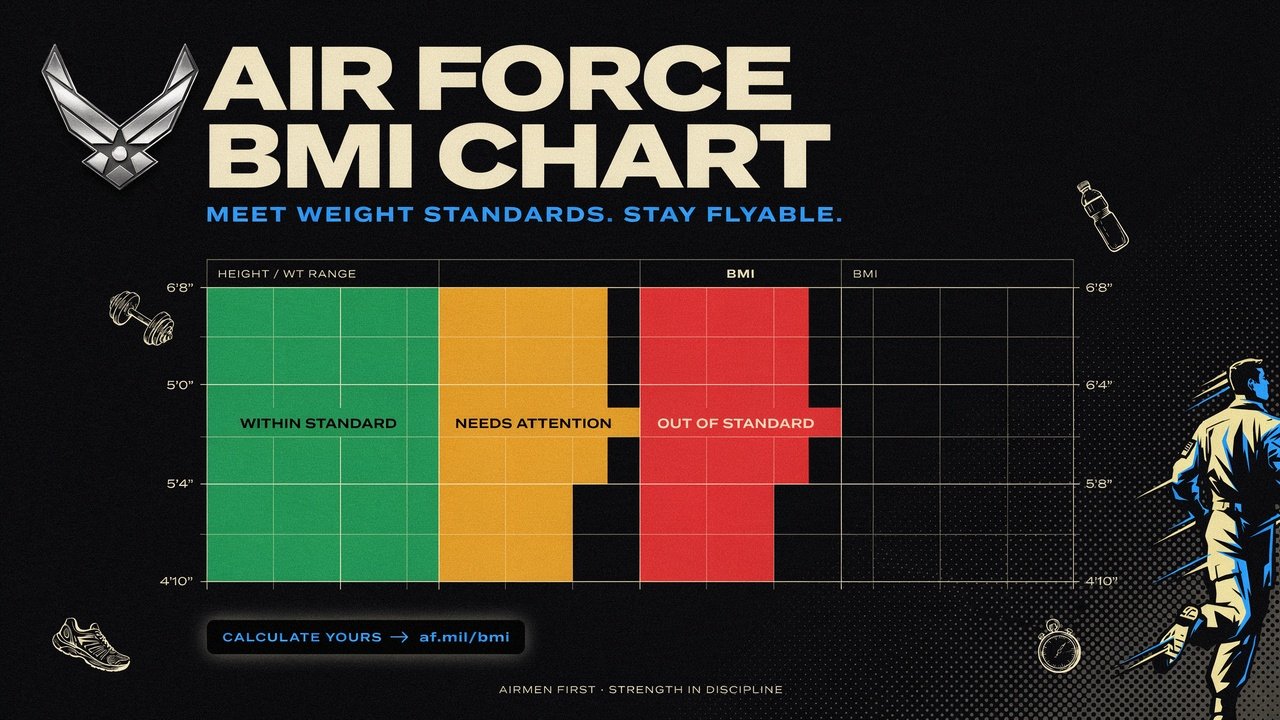
When it comes to joining the U.S. Air Force, understanding the AirForce BMI chart is important. This chart plays a vital role in ensuring that recruits and active members meet the necessary weight standards.
The body mass index (BMI) is the first checkpoint, helping assess whether you’re in the right ballpark based on your height and weight.
Check your BMI with our calculator 👉
For anyone thinking about serving, this information is essential. The height and weight tables cover individuals from 58 inches to 80 inches tall. This means that if you’re on the shorter side, your minimum weight starts at 91 pounds, while those taller have a maximum of 250 pounds. The standards apply equally to both males and females, a policy in place since 2004.
So, why does this matter? It’s about ensuring your body composition supports the physical demands of service. The Air Force BMI chart gives you a clear target to aim for, and the process starts with a simple health screening. By the end of this guide, you’ll be well-prepared and confident in your journey.
Key Takeaways
- The Air Force BMI chart is essential for recruits and active personnel.
- It assesses if individuals meet the necessary weight standards.
- Height and weight tables are used to determine if you’re in the right range.
- Body composition is crucial for meeting physical demands.
- The process begins with a health screening.
- Understanding these standards can help you prepare effectively.
What Is the Airforce BMI Chart and Why It Matters
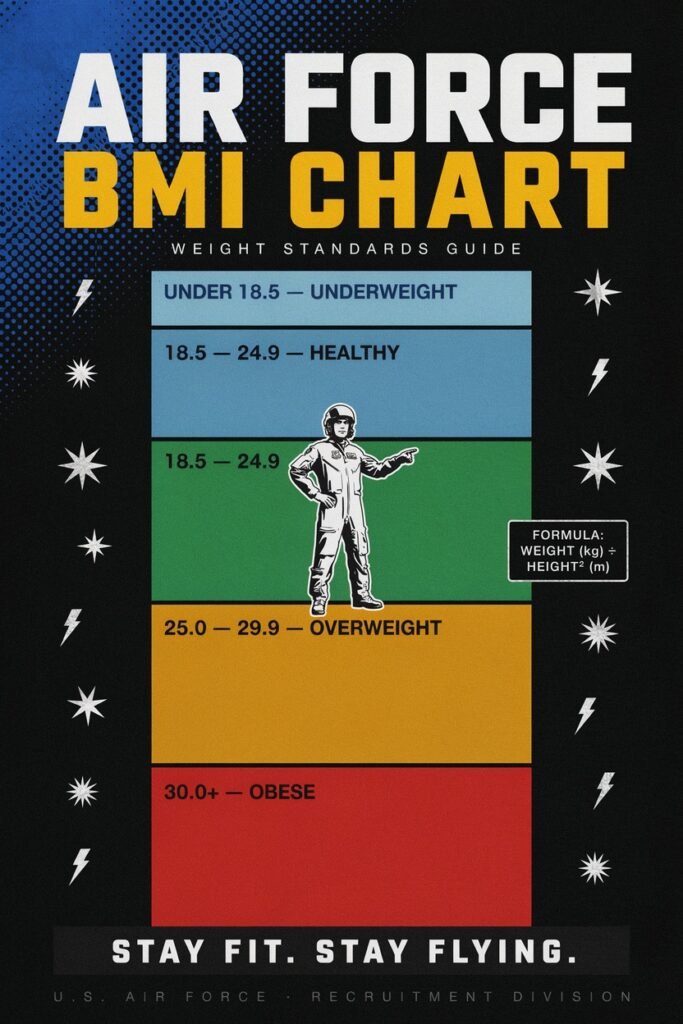
Understanding the BMI requirements is key for anyone considering a career in the Air Force. The body mass index is calculated using your height and weight. This simple formula provides a target range that helps you assess your physical readiness.
The Air Force uses a height and weight table that covers individuals from 58 to 80 inches tall. For instance, a recruit who stands at 64 inches should weigh between 110 and 160 pounds. At 72 inches, the acceptable range is 140 to 202 pounds. This chart serves as a straightforward guide to help you stay within the required limits.
Basics of BMI and How It’s Used in the Air Force
The BMI is not just a number; it’s a reflection of your overall body composition. It’s important to remember that muscle weighs more than fat. This means you could be heavier yet still be fit and healthy. The Air Force prefers using this chart instead of making recruits do complicated math.
Difference Between BMI and Body Fat Percentage
While BMI gives a quick overview, body fat percentage is a more precise measure of your health. The maximum body fat allowed is 20% for males under 30 and 28% for females under 30 at MEPS. At the Air Force Academy, these numbers drop to 18% for males and 26% for females. This distinction is crucial because you can still pass even if your weight is above the BMI range, as long as your body fat percentage is acceptable.
How the Chart Helps Meet Service Requirements
The BMI chart acts as a first filter. If you’re within the range, you’re good to go. If not, the next step is a body fat test. These standards aren’t arbitrary; they stem from years of research to determine what body mass supports peak performance in the field.
At MEPS, your height and weight are officially measured. This process is not meant to punish but to ensure that all recruits meet the health baseline necessary for duty. Knowing your body mass index ahead of time allows you to adjust your training and eating habits before you even step into a recruiting office.
Even if you find yourself outside the recommended range, the body fat test gives you a second chance to qualify. It’s all about helping you succeed in your journey to serve in the U.S. Air Force.
For more detailed calculations, check out this BMI calculator.
Air Force Height and Weight Standards You Need to Know
If you’re looking to join the U.S. Air Force, knowing the height and weight standards is essential. These standards help ensure that all recruits meet the necessary physical requirements for service. Below, we’ll break down the official height and weight tables, making it easier for you to see where you stand.
Official Height and Weight Tables for Recruits
The Air Force has specific weight requirements based on height. Here’s a look at the official tables:
| Height (inches) | Weight Range (pounds) |
|---|---|
| 58 | 91 – 131 |
| 59 | 94 – 136 |
| 60 | 97 – 141 |
| 61 | 100 – 145 |
| 62 | 104 – 150 |
| 63 | 107 – 155 |
| 64 | 110 – 160 |
| 65 | 114 – 165 |
| 66 | 117 – 170 |
| 67 | 121 – 175 |
| 68 | 125 – 180 |
| 69 | 128 – 186 |
| 70 | 132 – 191 |
| 71 | 136 – 197 |
| 72 | 140 – 202 |
| 73 | 144 – 208 |
| 74 | 148 – 214 |
| 75 | 152 – 220 |
| 76 | 156 – 225 |
| 77 | 160 – 231 |
| 78 | 164 – 237 |
| 79 | 168 – 244 |
| 80 | 173 – 250 |
Same Standards for Males and Females
Since 2004, the height and weight standards have been the same for both males and females. This change simplifies the process for all applicants. Your height will be measured without shoes, and your weight will be taken in standard PT gear at MEPS.
What Happens If You’re Over or Underweight
If you come in over the maximum weight, don’t worry! You won’t be automatically disqualified. Instead, a body fat measurement will be conducted. This assessment is your chance to still qualify for service.
On the flip side, being underweight can also be a concern. The Air Force looks for a healthy body composition in all applicants, whether you’re going enlisted or aiming for the U.S. Air Force Academy.
Make sure to check your numbers against the table now. Knowing where you stand can help you prepare effectively and avoid surprises later on.
Understanding Body Fat Measurements in the Air Force
Body fat measurements play a significant role in determining your eligibility for the U.S. Air Force. If you exceed the weight limit for your height, these measurements come into play. They help assess whether your body composition meets the necessary standards for service.
When Body Fat Comes Into Play
Body fat measurements are only considered if you tip the scales over the maximum weight for your height. This is crucial because it allows for a more accurate evaluation of your fitness level.
Maximum Body Fat Percentages for Men and Women
The maximum allowable body fat percentages are clearly defined. For males under 30, the limit is 20% at MEPS, while it drops to 18% at the Air Force Academy. For females, the limits are 28% and 26%, respectively. These standards ensure that all recruits maintain a healthy body composition.
How Body Fat Is Measured and Assessed
Check your BMI with our calculator 👉
Body fat is measured using a tape test methodology. For men, measurements are taken around the neck and waist. Women have their neck, waist, and hips measured. These numbers are plugged into a formula that estimates body composition.
Age doesn’t change the standards at the entry level, which is different from some other branches. The ratio between your neck and waist plays a significant role in the calculation. Interestingly, building neck muscle can actually help improve your results.
The measurement process is quick and straightforward. Trained personnel conduct the tests in a private setting, ensuring your comfort and confidentiality. This approach is much fairer than relying solely on weight, as it accounts for muscle mass as well.
The U.S. Air Force is concerned about your overall health and fitness level, not just a number on the scale. If you’re close to the limits, focusing on reducing body fat through diet and exercise is a smart move. Remember, the body mass you carry should be functional, readying you for the physical demands ahead.
Medical and Physical Requirements Beyond the BMI Chart
Before stepping into the recruitment office, it’s vital to know the full range of medical and physical requirements for the Air Force. Understanding these standards ensures that you’re fully prepared for what lies ahead. Let’s break down the key areas you need to focus on.
Height, Vision, and Hearing Standards
Your height must be between 4’10” (58 inches) and 6’8″ (80 inches). This range accommodates most individuals, but it’s always a good idea to measure yourself accurately.
When it comes to vision, you need to correct to at least 20/40 in each eye, whether through glasses or contacts. The limits for refractive error are between -8.00 to +8.00 diopters spherical equivalent, with a maximum astigmatism of 3.00 diopters.
Hearing tests are also a crucial part of the evaluation. You must have no more than a 25 dB average at 500, 1000, and 2000 Hz, with no single level exceeding 30 dB. At 3000 Hz, the limit is 35 dB, and at 4000 Hz, it’s 45 dB.
Tattoo, Brand, and Piercing Regulations
When it comes to tattoos, there are strict regulations to keep in mind. Tattoos on the hands, head, neck, face, tongue, lips, eyes, and scalp are prohibited. Additionally, any tattoos associated with gangs, extremists, or that are deemed indecent are banned.
As for piercings, you’ll need to remove all of them before starting basic training. This is something to plan for if you have any piercings.
Special Notes on Aviation and Pilot Vision Rules
If you’re aiming for a career in aviation, be aware that the vision requirements are stricter. These standards are assessed during your sophomore year at the Academy. Refractive surgeries like PRK or LASIK can qualify cadets for aviation roles, but they must meet specific preoperative criteria. Importantly, applicants should avoid pursuing any refractive surgery within 180 days of the DoDMERB exam.
Keep in mind that the U.S. Air Force Academy has its own set of body composition and health standards that are slightly tighter. All these requirements exist to ensure that every airman and officer is fit for duty from day one.
Training Tips to Meet and Maintain Airforce Weight Standards
Getting ready for the U.S. Air Force means understanding how to meet and maintain weight standards. It’s not just about passing the fitness test; it’s about creating a lifestyle that supports your goals. Here are some tips to help you stay on track.
Creating a Personal Workout Routine
Start by developing a workout routine that fits your lifestyle. Avoid cookie-cutter programs that you might quit after a week. Instead, focus on exercises you enjoy. Here are some key components to include:
- Push-ups
- Sit-ups
- Pull-ups or flexed arm hang
- Running
Stew Smith, a former Navy SEAL, recommends tailored programs that specifically target what the Air Force fitness test measures. Mixing cardio and strength training is the sweet spot for dropping body fat while keeping muscle.
Air Force Fitness Test Focus: Push-ups, Running, and More
The fitness test isn’t a one-and-done deal. You’ll be tested regularly throughout your career, so building habits now pays off. Focus on the big three exercises: push-ups, sit-ups, and running. If you’re feeling ambitious, add pull-ups to your routine.
Staying Consistent During Training and Service
Consistency is key. You can start at whatever fitness level you’re at right now and build up gradually. Remember, it’s more important to maintain a steady routine than to go hard for a couple of weeks and then burn out.
Tracking your measurements every couple of weeks can keep you motivated. You’ll see body mass shifting even if the scale doesn’t move. Training for the test is really just training for a healthier life in and out of the U.S. Air Force.
Keeping on Track with Your Air Force Fitness Journey
Embarking on a journey in the military means understanding the path to fitness. Once you’ve reached your goals, remember that maintaining your health is a lifelong commitment. The standards don’t just disappear after basic training; you’ll face regular tests throughout your service.
The habits you build now—eating right, staying active, and getting enough sleep—will support you for decades. Both the Air Force and Space Force share similar body composition requirements, so this information applies across branches.
If you hit a rough patch, don’t worry! There are resources and programs to help you get back on track. Your age may shift expectations slightly, but the core requirements remain steady. Reach out to recruiters for the most current information and personalized guidance.
Even if you don’t hit the mark on your first try, waivers and remeasurements exist for competitive candidates. Taking control of your health now sets you up for a strong result, no matter your path. Remember, your fitness journey is about becoming the best version of yourself, and that’s worth the effort!