
Have you ever noticed how often people choose seven when asked to pick a number between one and ten? It’s not just a coincidence! This fascinating number pops up everywhere. Think about it: seven days in a week, seven wonders of the world, and even seven colors in a rainbow. There’s something special about it.
In a recent poll by mathematician Alex Bellos, over 44,000 people voted, and guess what? Nearly 10 percent picked seven as their favorite! Voters mentioned that numbers often represent significant dates or simply feel warm and friendly. Odd numbers, like seven, tend to feel more appealing than even ones, while round numbers like ten can feel too vague.
Interestingly, eight came in third for its symmetry and cultural ties to prosperity, while three took second place due to its frequent appearances in stories and nature. So, could the charm of seven be more about math than magic? Let’s explore this captivating number together!
Key Takeaways
- People often choose seven as their favorite number.
- Seven appears in various cultural references and natural phenomena.
- A poll showed that seven is the most popular number worldwide.
- Odd numbers tend to be more appealing than even ones.
- Eight and three also have significant cultural meanings.
Why Is 7 a Lucky Number? The Basics and Common Wonders
It’s common to hear that seven is a lucky number, but what’s the story behind it? This section dives into the fascinating reasons that make this number stand out. From the seven days of the week to the seven notes on a musical scale, the number seven appears in many basic structures of life. This repetition creates a sense of familiarity and comfort.
Our fascination with this number isn’t new. Ancient Babylonian tablets were filled with references to sevens, showing that this intrigue has existed for thousands of years. Mathematician Alex Bellos notes that future historians might see our modern gambling culture, especially in Las Vegas, as a testament to this obsession. Slot machines and craps tables revolve around the number seven, proving its appeal has never faded.
One interesting quirk about the number seven is its uniqueness in the realm of basic numbers. It’s the only number between one and ten that can’t be divided or multiplied by another number in that same group. For example, while one through five can be doubled to reach another number, and nine is divisible by three, seven stands alone.
This solitary nature makes seven feel like a loner, an outsider in the world of numbers. People often interpret this property culturally, adding to its mystique. When you group things in sevens, they tend to feel special too. This is why we often see lists of seven throughout history.
| Aspect | Details |
|---|---|
| Occurrences | Seven days in a week, seven notes in a scale |
| Historical References | Ancient Babylonian tablets |
| Modern Culture | Gambling in Las Vegas, slot machines |
| Mathematical Uniqueness | Only number from 1-10 not divisible by others in the set |
How Seven Shows Up in Culture and Religion
Look around, and you’ll see that the number seven pops up in various cultures and religions across the globe. It’s kind of amazing how consistent that is. In Western religion, for instance, the Bible tells us that God created the world in six days and rested on the seventh. This sets up seven as a symbol of wholeness and completion throughout scripture.
Seven in Western Religion and Myth
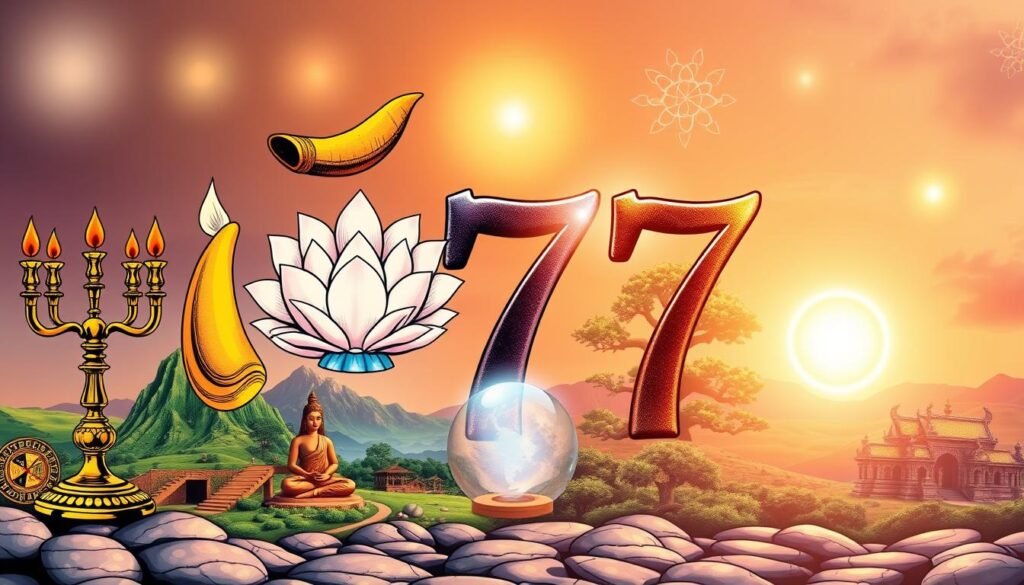
Islam and Judaism also recognize the significance of seven. Both traditions describe seven heavens, and during the pilgrimage to Mecca, Muslim pilgrims circle the Kaaba seven times. This shows how the number marks sacred actions in their faiths.
Hinduism adds to this rich tapestry with its concept of seven higher worlds and seven underworlds. In Buddhism, the newborn Buddha takes seven steps right after birth, symbolizing his journey towards enlightenment. Clearly, this number resonates beyond just one culture.
The Role of Seven in Chinese Culture
Transitioning to Chinese culture, we find that in Confucianism, seven combines yin, yang, and the five elements to represent harmony. Taoism links seven to the Tao itself, emphasizing kindness and beauty. One of the most romantic stories associated with seven is the Double Seventh Festival on July 7th. This festival celebrates the annual reunion of the Cowherd and the Weaving Maid across the Milky Way on a bridge formed by magpies, making it akin to China’s Valentine’s Day.
Additionally, ancient Chinese culture references the Seven Treasures of Buddhist Scripture: gold, silver, colored glaze, coral, amber, seashell, and agate. The phrase “to create a poem within seven steps” comes from Cao Zhi during the Three Kingdoms Period, showcasing cleverness and creativity. Zhuge Liang’s strategy of “Seven Arrests and Seven Releases” also highlights the number’s connection to persistence.
However, seven isn’t always viewed positively in Chinese culture. The July 7th Incident of 1937 serves as a painful reminder of the Sino-Japanese War. Plus, the word for seven sounds like the word for cheating, leading some to avoid it in phone numbers.
In conclusion, whether in Western myth or Eastern tradition, the number seven carries a weight that few other numbers can claim. Its presence in various cultures and religions shows just how special this number truly is.
What Math Has to Do with Seven’s Charm
Math can sometimes seem boring, but when it comes to the number seven, there’s a fascinating story waiting to be told. First off, seven is the fourth prime number. This means it can’t be divided evenly by anything except one and itself. That already sets it apart from most other numbers.
Interestingly, among numbers one through ten, seven is the only one that can’t be doubled or divided to land on another number in that same group. This makes it a total loner, as noted by mathematician Alex Bellos.
Now, let’s talk about some fun probability facts. When rolling two standard six-sided dice, there’s a 1 in 6 chance of landing on seven. That’s higher than any other total! Plus, the opposite sides of a standard die always add up to seven.
Ever heard of a heptagon? It’s a seven-sided shape and the first regular polygon that can’t be drawn perfectly with just a compass and straightedge. Ancient Greek mathematicians would have found this both frustrating and fascinating.
Here’s something curious: when you divide one by seven, you get a repeating decimal of six digits—0.142857. Even more interesting, if you divide 999,999 by seven, you get exactly 142,857, which feels almost magical.
In the world of math, there are seven Millennium Prize Problems, with a million-dollar reward for solving each one. Six of them remain unsolved, tying seven to some of the deepest mysteries in mathematics.
All these mathematical quirks add up to a number that feels special. This significance is layered on top of the cultural and religious meanings we’ve already explored.
| Mathematical Aspect | Details |
|---|---|
| Prime Number | Fourth prime number, cannot be divided evenly by any other number except one and itself. |
| Probability | 1 in 6 chance of rolling a seven with two dice. |
| Geometric Shape | Heptagon is the first regular polygon that can’t be constructed with just a compass and straightedge. |
| Decimal Representation | 1 divided by 7 equals 0.142857 (repeating). |
| Millennium Prize Problems | Seven problems exist, six still unsolved. |
The Psychology: Why People Are Drawn to Seven
Psychology reveals fascinating insights into our attraction to the number seven. It’s not merely superstition or tradition that draws us in. In fact, when you ask someone to pick a number between one and ten, seven tends to pop up far more often than random chance would suggest. This hints at something deeper going on in our minds.
Odd numbers generally spark more interest than even ones. Numbers ending in zero or five can feel too round and vague, lacking personality. This makes seven stand out as a unique choice. The ancient Pythagoreans recognized this too. They viewed seven as a blend of the physical world, represented by four, and the spiritual world, symbolized by three. This combination gives seven a deeper significance that resonates even today.
People who favor seven often display certain personality traits:
- Analytical Mind: They love exploring the reasons behind things.
- Curiosity: A strong desire to understand causes and effects.
- Intuition: They possess a keen sense of intuition, guiding their decisions.
- Philosophical Nature: A calm, thoughtful approach to life’s challenges.
- Unique Aesthetic Sense: They often appreciate beauty in unconventional ways.
However, there’s a flip side. Those drawn to seven can sometimes feel lonely or come across as indifferent. They may trust their judgment more than others, which can lead to avoiding help from friends. This tendency to be withdrawn can make them seem distant, even if they genuinely care.
Whether or not you believe in numerology, the allure of seven reflects how our minds work. It captures a blend of analytical thought and deep introspection, contributing to its status as a cherished number. For those interested in diving deeper into the spiritual meaning of seven, check out this resource.

Seven in Popular Stories and Everyday Life
Once you start spotting the number seven in everyday life, you’ll be amazed at how often it appears. It’s kind of fun how many places it pops up! Think about the seven days in a week or the seven colors in a rainbow. These basic structures shape how we experience the world.
Fairy tales and stories often reach for this number too. Remember Snow White and the seven dwarfs? Or how about the seven swans a-swimming from the Twelve Days of Christmas? Storytellers have always loved the number seven, making it a memorable part of their narratives.
Then there are the Seven Wonders of the World, both ancient and modern. Calling something one of the seven wonders instantly makes it feel more impressive and special. The seven deadly sins have also influenced art, literature, and movies for centuries, showcasing the number’s impact on culture.
In popular culture, the Seven Year Itch became a famous movie featuring Marilyn Monroe. This idea suggests that marriages often hit a rough patch around year seven, which has become part of how we talk about relationships.
Our entire weekly rhythm is built around seven days. Even though we don’t think about it much, that structure affects everything from work schedules to weekend plans. And let’s not forget how seven shows up in gambling and games of chance. It’s often the lucky number people bet on, reinforcing its reputation.
In short, the number seven is woven so deeply into stories and daily routines that we barely notice it anymore. But that’s exactly what makes it so powerful!
Wrapping Up: Why We Keep Loving Lucky Number Seven
After exploring the many facets of this fascinating number, it’s easy to see why it captures our hearts. Seven stands out as the rebel among one-to-ten, refusing to be divided or multiplied within its group. This unique quality makes it feel special, even if we don’t consciously think about it.
Across cultures and religions, seven has a revered status, woven into creation stories and sacred rituals. Our brains are naturally drawn to odd numbers, and seven strikes a perfect balance—complete yet not overly round.
From the seven days of the week to lists we create, this number structures our lives in practical ways. In numerology, it’s linked to introspection and wisdom, traits that resonate with many. If seven is your favorite, you’re in good company, embracing the independent thinkers and rebels of the world.
So, as we continue to celebrate this number, it’s clear that seven isn’t going anywhere. Now you know just why it remains the world’s favorite!